Between 2020 and 2026 pluginsolar has developed fantastically in Germany. From a niche product used by nerds in a grey area to a product category with a recognized standard and broad adoption. This was not foreseeable and happened in a contested space between users, tenants and landlord, standards authorities and many different actors from civil society, industry and government.
First ideas for something like PIPV appeared as early as the mid 1990s. But it needed until the end of 2010s until the first products appeared. From 2018 I was part of this development, first as a user, then as part of a working group of our local energy company and later as founder and member of the board of the Balkon.Solar e.V.
We can either call it PIPV, short for plug-in-pv or plug-in-solar. Other names include Balconsolar as in the beginning most systems were attached to balconies.
Definition
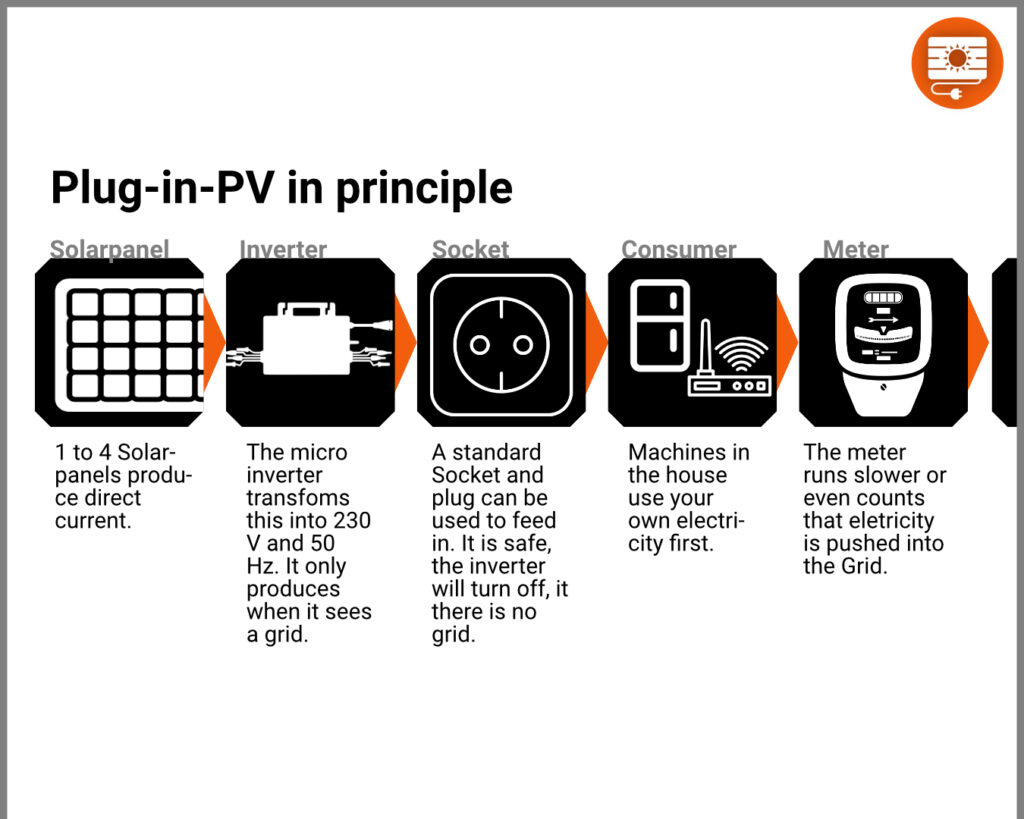
The core PIPV is one solar panel, connected by cable to a micro inverter. This micro inverter feeds the power into a socket – thus plug in – and consumers in the house use this power first. This system is portable, in the sense that the consumer can unplug it at one place and plug it in at another place.
For this the consumer does not need an electrician or otherwise qualified person, which he has to pay for. The system is usable and installable by laypeople. Such as many other electric devices.
One Solarpanel, one microinverter, cable with plug together with mounting is a system that costs around 300 Euros. This would be the standard system in 2020.
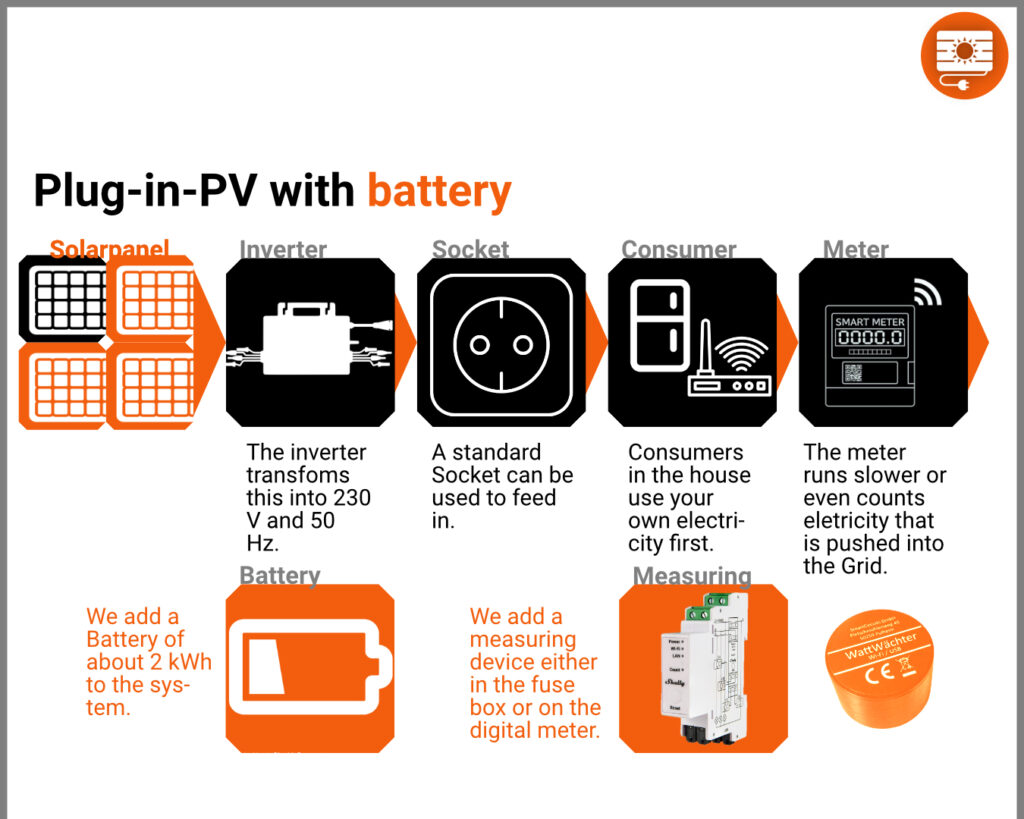
Over the last five years this setup has changed considerably with the addition of batteries. Batteries give the consumer the ability to transfer his own production from midday to the evening and night, when no sun is shining. The installation costs of such systems are higher, but also the amount of energy used. They can provide the consumer with other benefits such as emergency power.
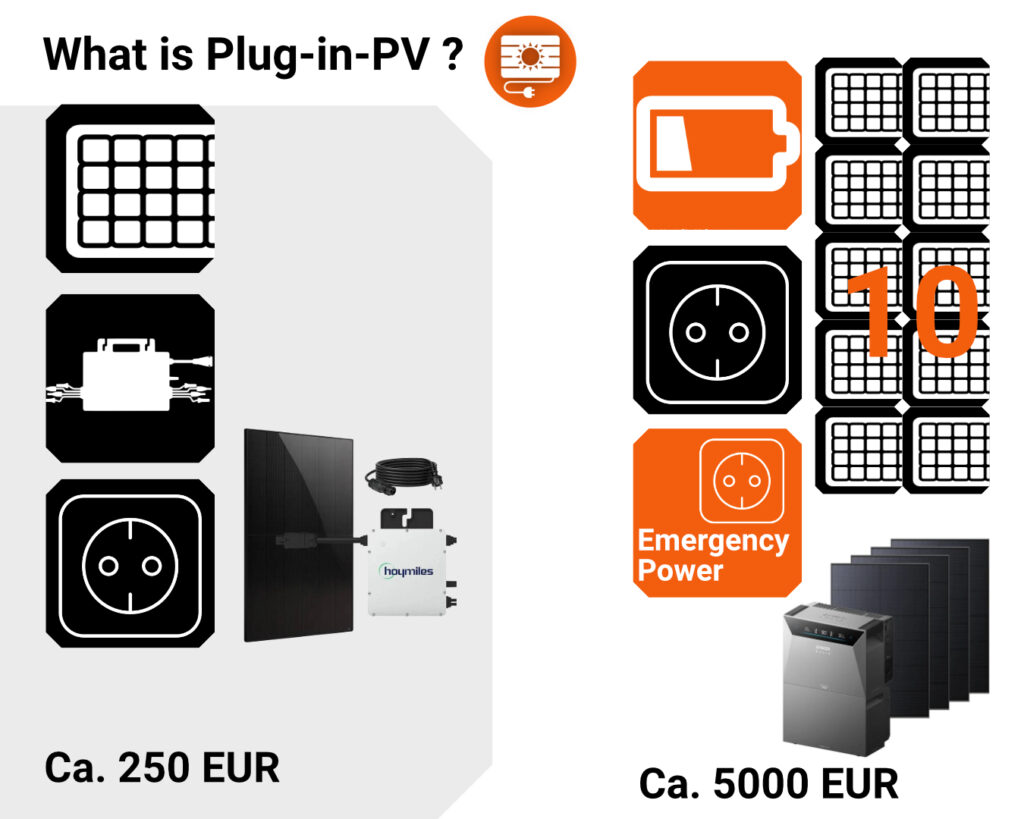
In 2026 the vendors introduced systems with:
- up 10 solarpanels
- 5 kWh battery
- 800 Watt feed in via standard socket
- 2000 Watt “emergency power socket”
- Infrared sensor on the digital meter or power meter in the fusebox
These systems are at the end around 3000 – 5000 EUR in total with mounting and they compete with roof top installations. But they are still marketed as “plug-in-solar”. These systems have more complexity, they are more expensive, but they still may have a cost recovery time of around 10 years and additional functions such as emergency power.
Some of these systems are part of stackable solutions, where consumers can add more battery, more solar input, piece by piece over time. Similar to stacked component audio systems of the 1980s.
Examples for solar systems like this are BK215 where you buy a head unit, additional power storage/input units and/or Wallbox AC-Output for a car. Thus the consumer can start with a small system and if he (usually he) has enough space can build a large system over time.
Most of the companies offering plug-in-solar and battery systems are trying to sell an entire ecosystem of smart home devices, car chargers, wallbox, heatpump and so on to their customers.
In some parts of society having a solar system or building a solar system has become a similar status symbol or even a kind of Conspicuous consumption, where people buy systems way too large for their needs and then are very proud of showing their production and savings on others on their phone.
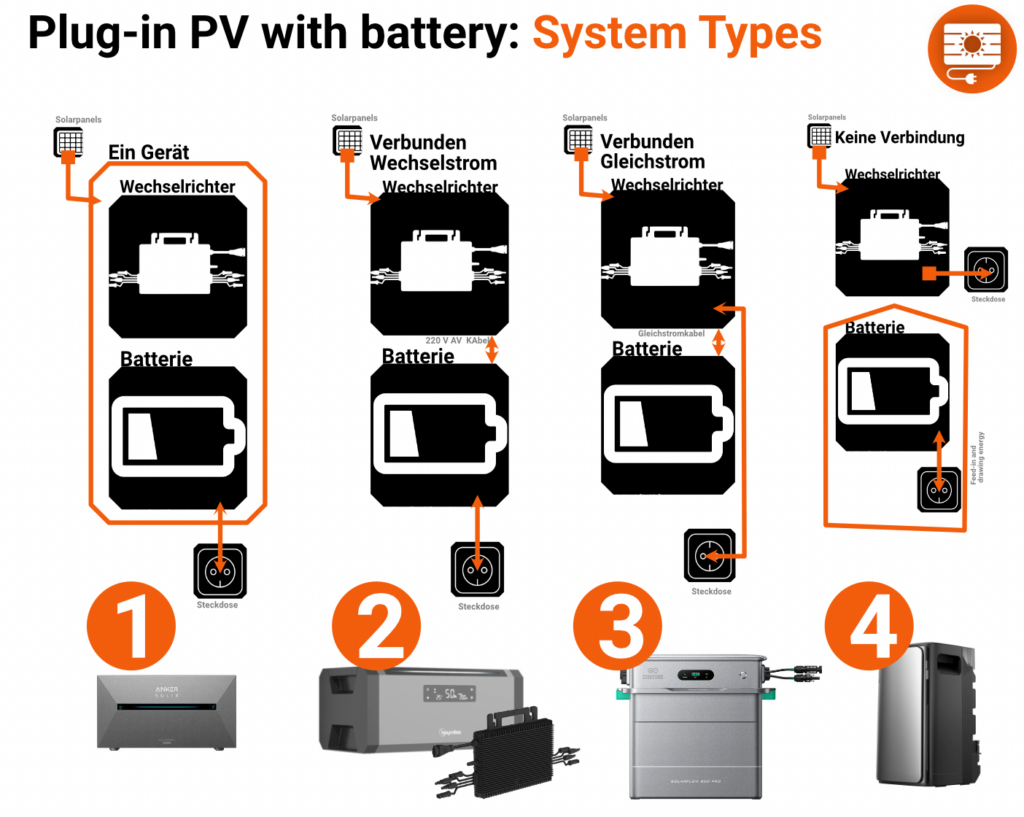
Battery and inverter in one box, DC connected. Battery and inverter separate, DC connected
Bettery and inverter separate AC connected. Or inverter at one place and then battery at some other place in the household, connected via the household electrical wires. The latter has the advantage that the manufacturer can sell you a battery for every room and you can plug in energy intensive appliances into it and they can draw from the battery.
A lot of the innovation is driven by the sales of vendors and manufactures. Setting technical and safety standards is often a process that comes after the products appear on the market. For example: We estimate that there are at least 1 Mio plug-in-solar with battery systems on the German market, but VDE is still in the process of developing a norm and we estimate that this specific product norm will not be published before 2027.
Who buys PIPV in Germany?
In May 2025 verivox made a representative survey – methodology not really disclosed. They then published the following data: “Around 9 percent of respondents state that they already operate a mini solar system, while another 17 percent plan to purchase one. Approximately 21 percent of respondents have no space for a balcony solar system, and 15 percent indicate that a mini solar system would not be worthwhile for them. 19 percent of respondents do not want a balcony solar system at all, and another 19 percent have not yet decided.”
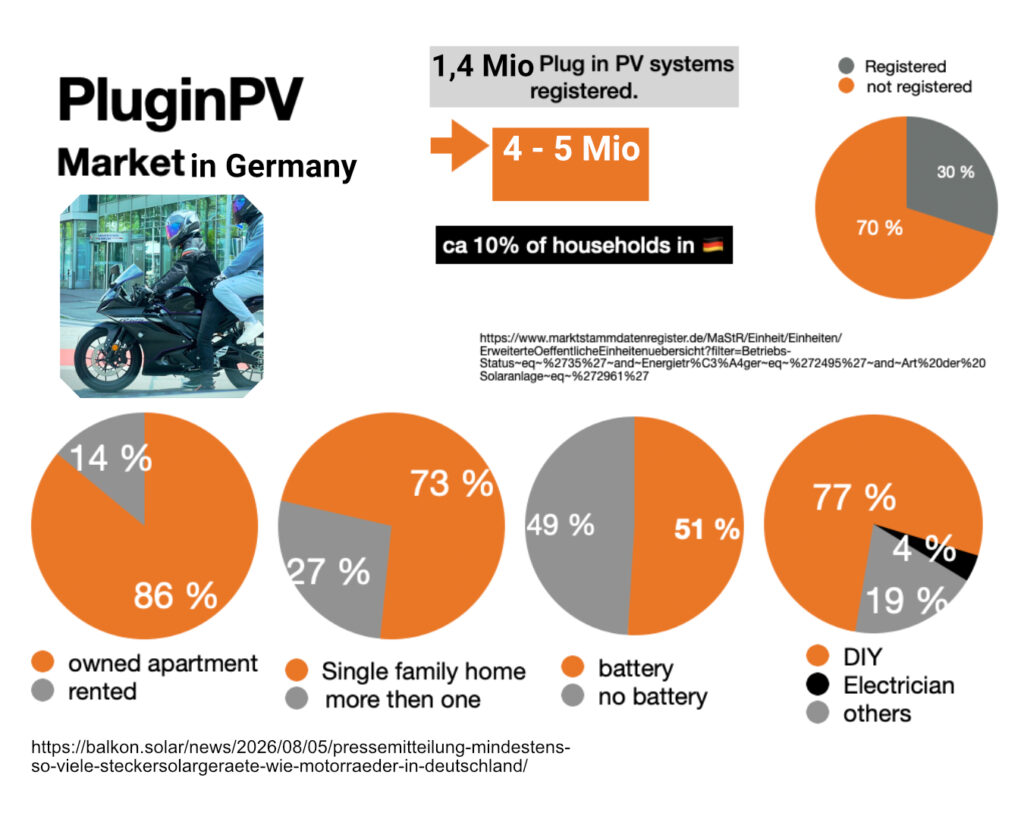
There are 41 Million households in Germany, 9% are 3,69 Mio. This would correspond with our 4 Mio Estimate in 2025. And if 17 % plan to purchase one, there would be space at least for 6.97 Mio PIPV systems.
Buyers of PIPV systems are usually people who do not intend to move in the foreseeable future. These are either couples 50+ without kids or to a smaller extent young families with children. When men buy it the technical aspect seems to be more important, when women lead the purchase it’s often more associated with saving money or economic housekeeping.
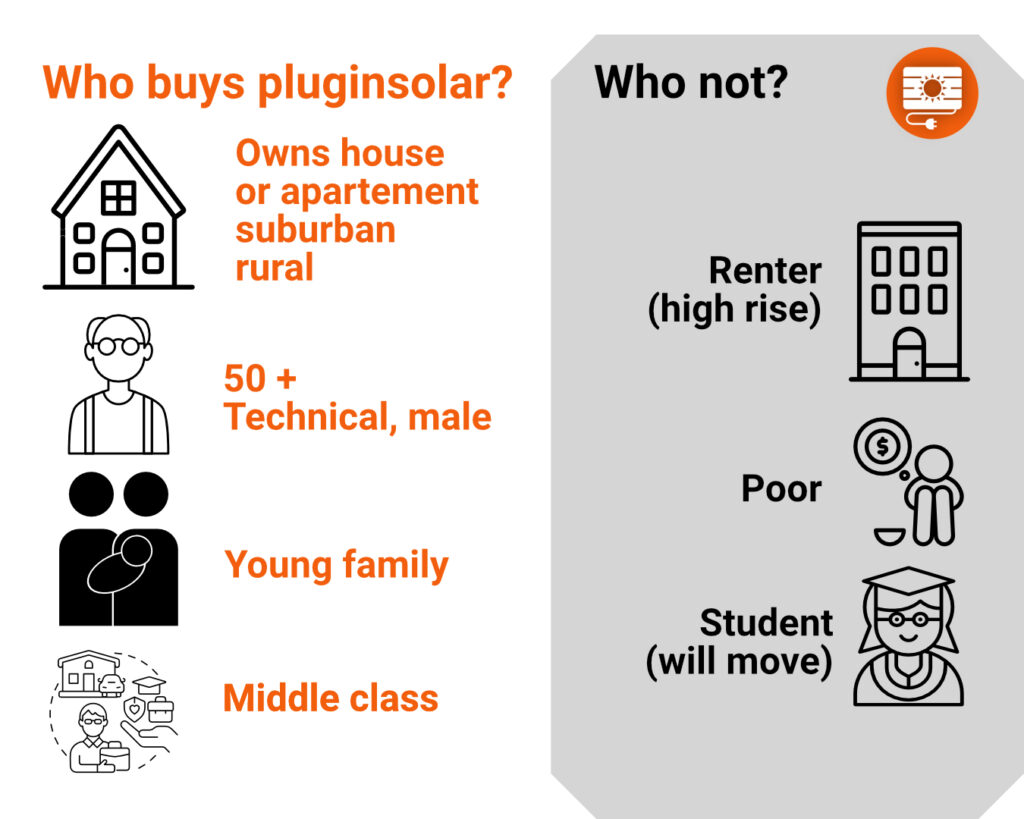
Usually the people who buy either own a house or at least a flat. Renting is not that often the case. House ownership and DIY affinity is higher in rural areas, often connected with former or part time farming. Typically a house in a rural village, with a person that is used to do practical work, but not necessarily as their job.
Atypical consumers are low income renters in inner city high rise buildings, single elderly ladies or students. Students because they do not know where they will live after their degree finishes (and student housing does often include electricity), poor people because they can not spare 300 EUR and low income tenants in inner city would need to fight their landlord for permission.
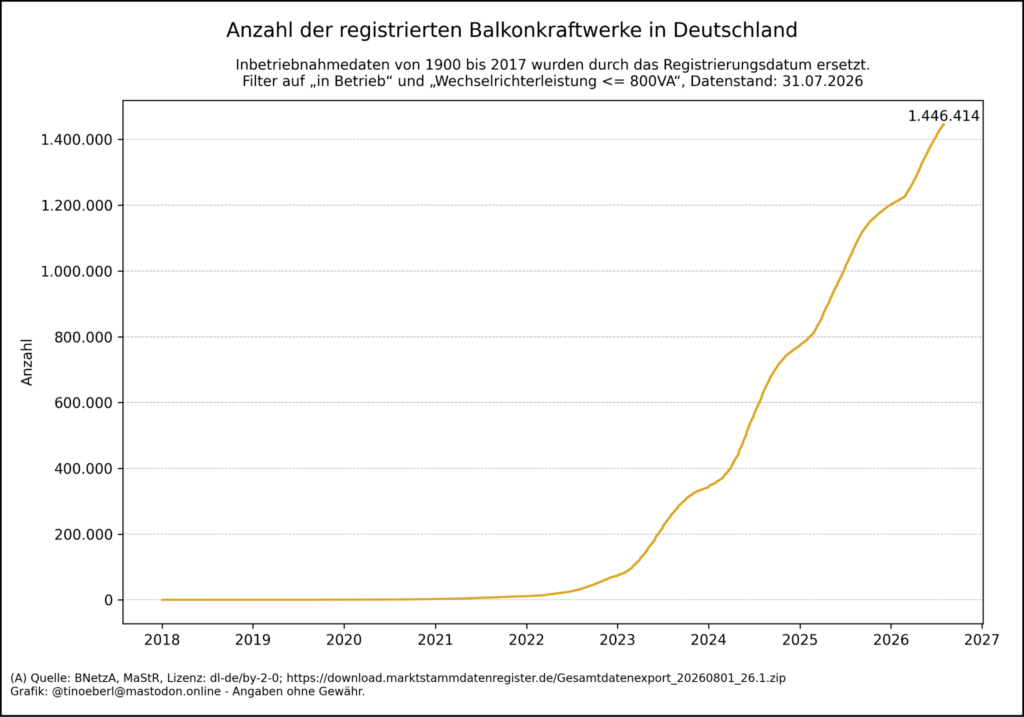
As you can see there are about 400.000 systems registered each year. And a total of 1.4 Mio. From surveys among our members, from asking companies how much they sold and from other data we estimate that about ¼ to ½ of the systems are registered. This leads us to 4,2 to 5,6 Mio. Systems. We would estimate that this means roughly 1 Mio Systems per Year. Usually sold between Spring and Fall (March to Oktober).
Now we can make a wild guess about turn over. We would estimate that about ½ are with a battery and ½ without. This is a number we got from asking large online retail shops.
Arguments for PIPV
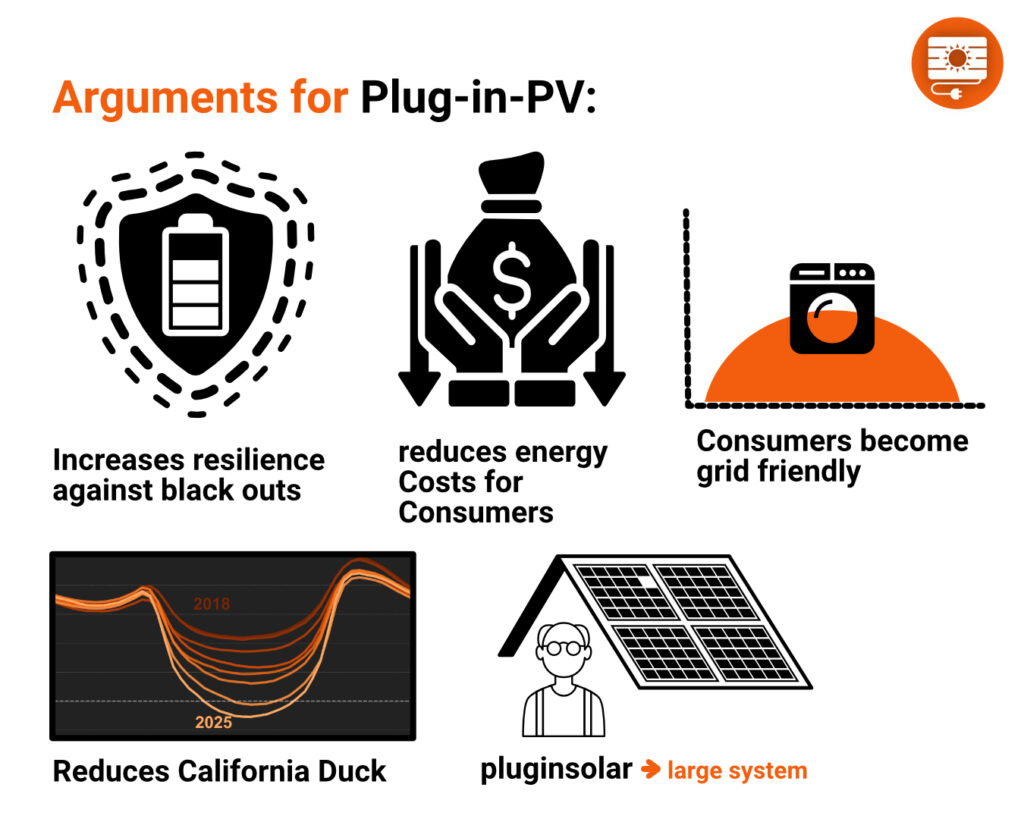
PIPV with a battery can offer an emergency power supply, and vulnerable people who may need CPAP machines or refrigerated insulin can stay at home and not need to go to hospitals.
Safety
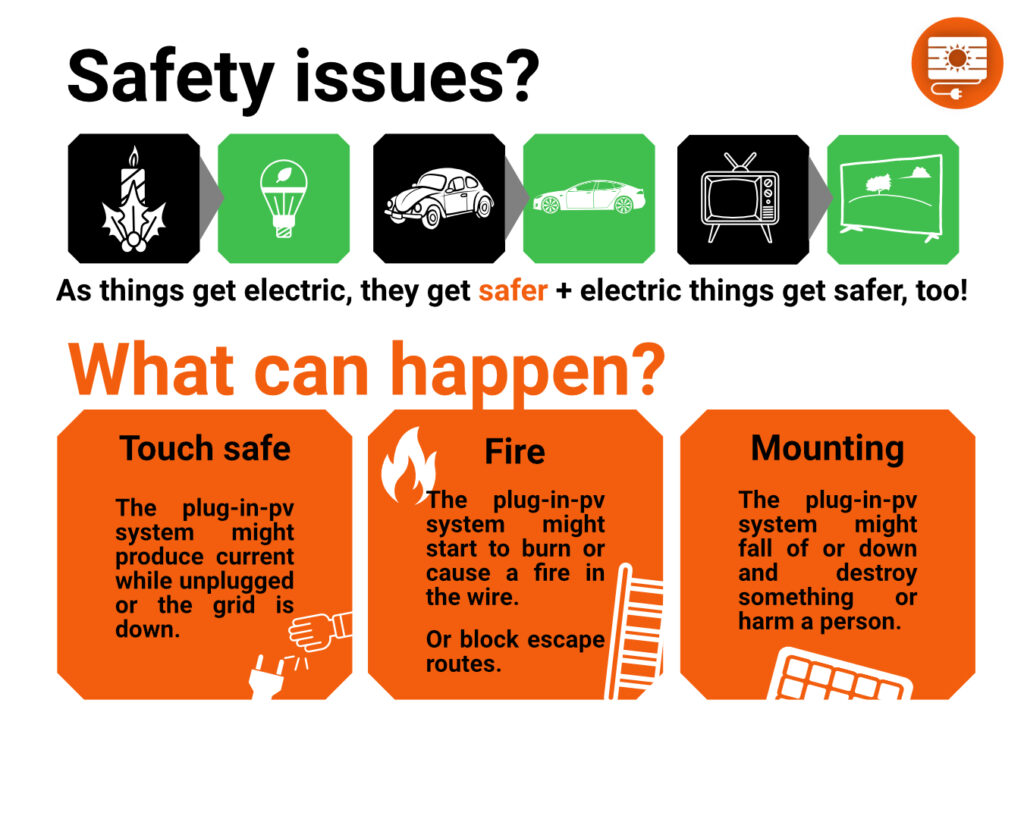
The “Working Group of Heads of Professional Fire Departments and the German Firefighters Association” in a recommendation regarding the “handling of photovoltaic systems,” said about PIPV systems: “The technical committee is currently unaware of any fire safety issues.”
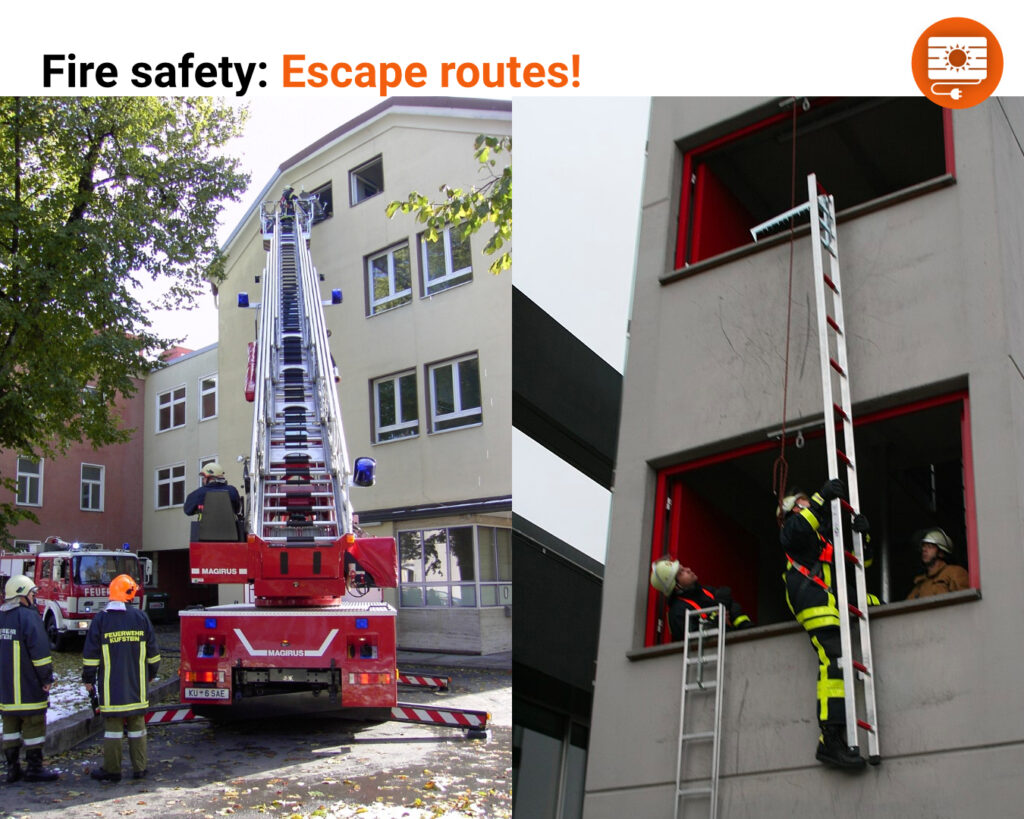
It continued its statement: “There are no objections below the high-rise threshold, provided that the availability of a second means of escape is not compromised. In this context, it must be ensured that rescue ladders do not need to be positioned directly against the module. To this end, it is sufficient to keep the modules clear of the clear width of rescue windows plus a 10 cm margin on both sides, and—in the case of balconies designated for ladder access—to keep a 1-meter-wide section of the railing free of modules.”
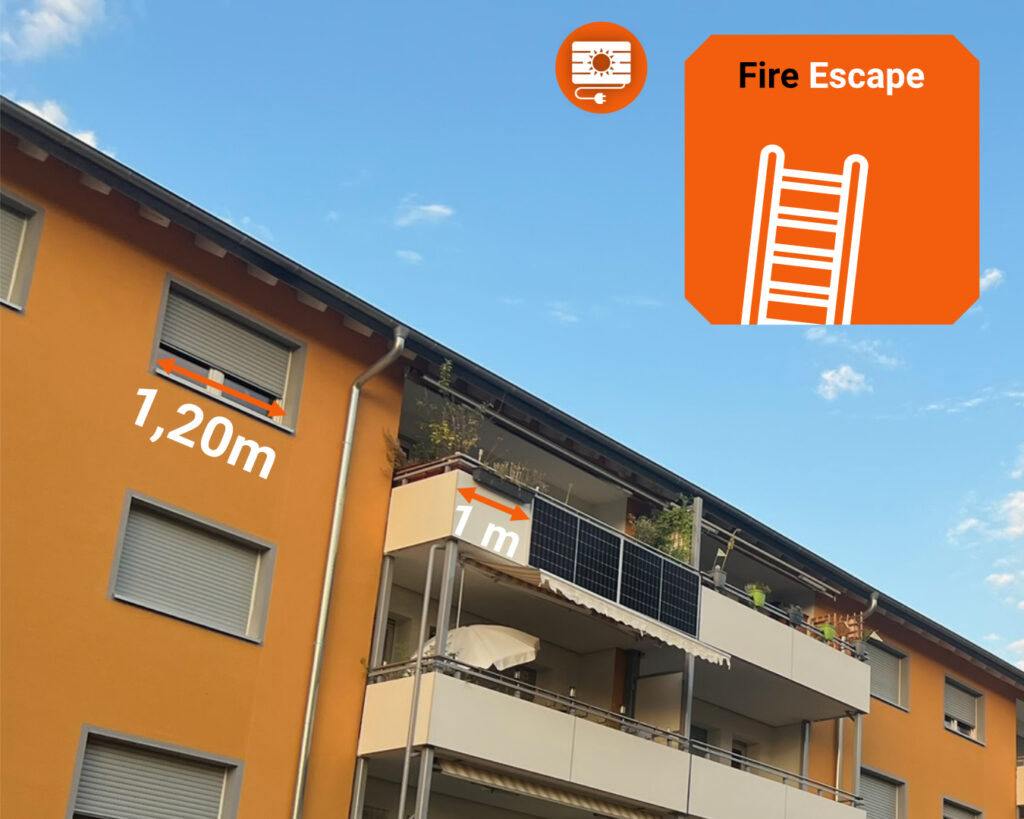
The Working Group also states: “Electrical hazard: All components of a balcony solar system are insulated and therefore safe to touch. If components are damaged—for example, by a ladder or exposure to fire—a safety distance of 1 meter must be maintained in accordance with DIN VDE 0132 (analogous to the procedure for any other damaged electrical devices, cables, or power strips). If the balcony solar system’s plug is disconnected or mains voltage is lost, the inverter shuts down very quickly. „There is then no longer 230 V present at the plug (e.g., Schuko plug) (shutdown upon mains failure).“
So even in the case of a fire, they do not see any problems.
Overheating the cable?
Another issue often discussed is overheating the cable or wires in the house. Before a German technical norm was published extensive studies were done around German housing.
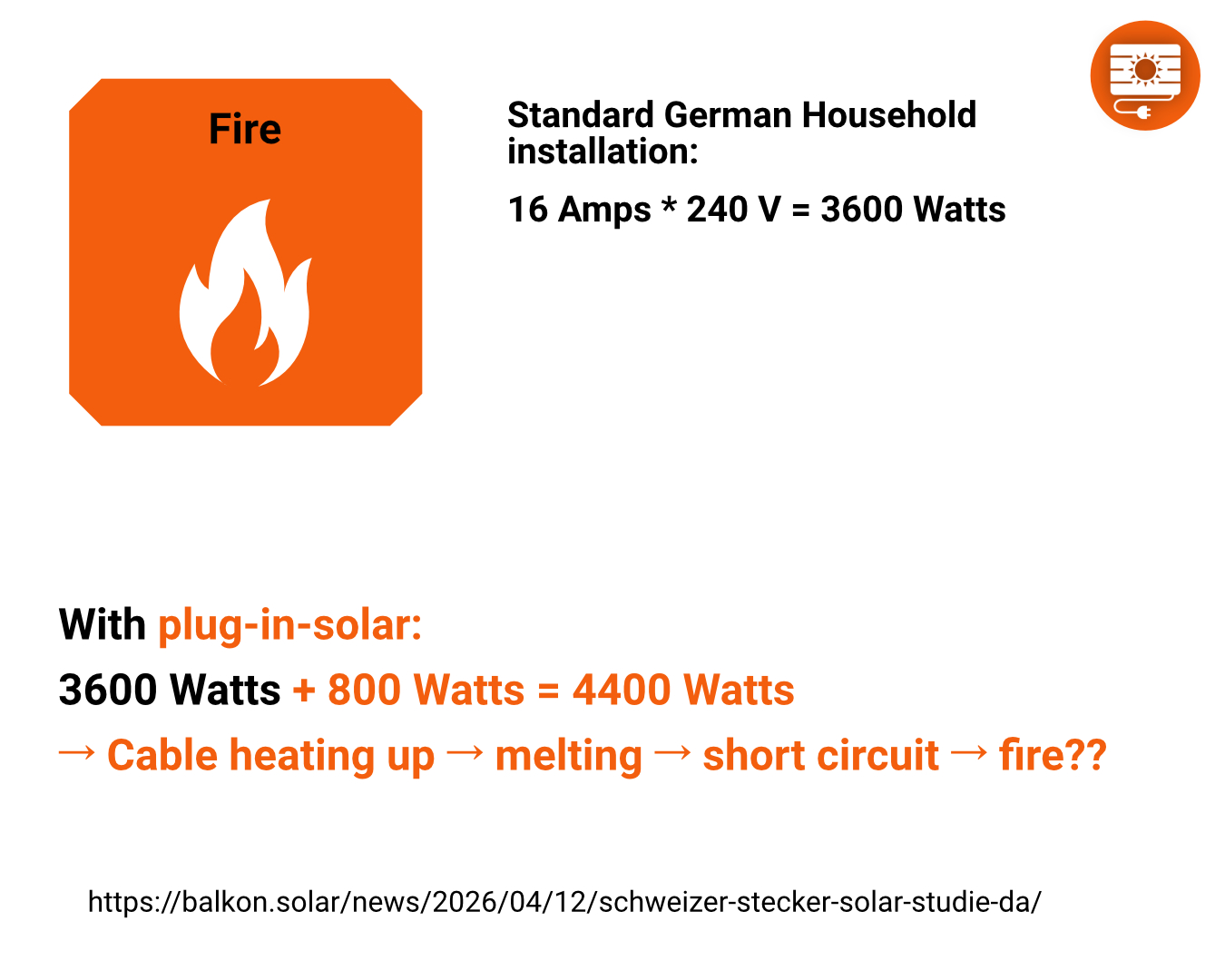
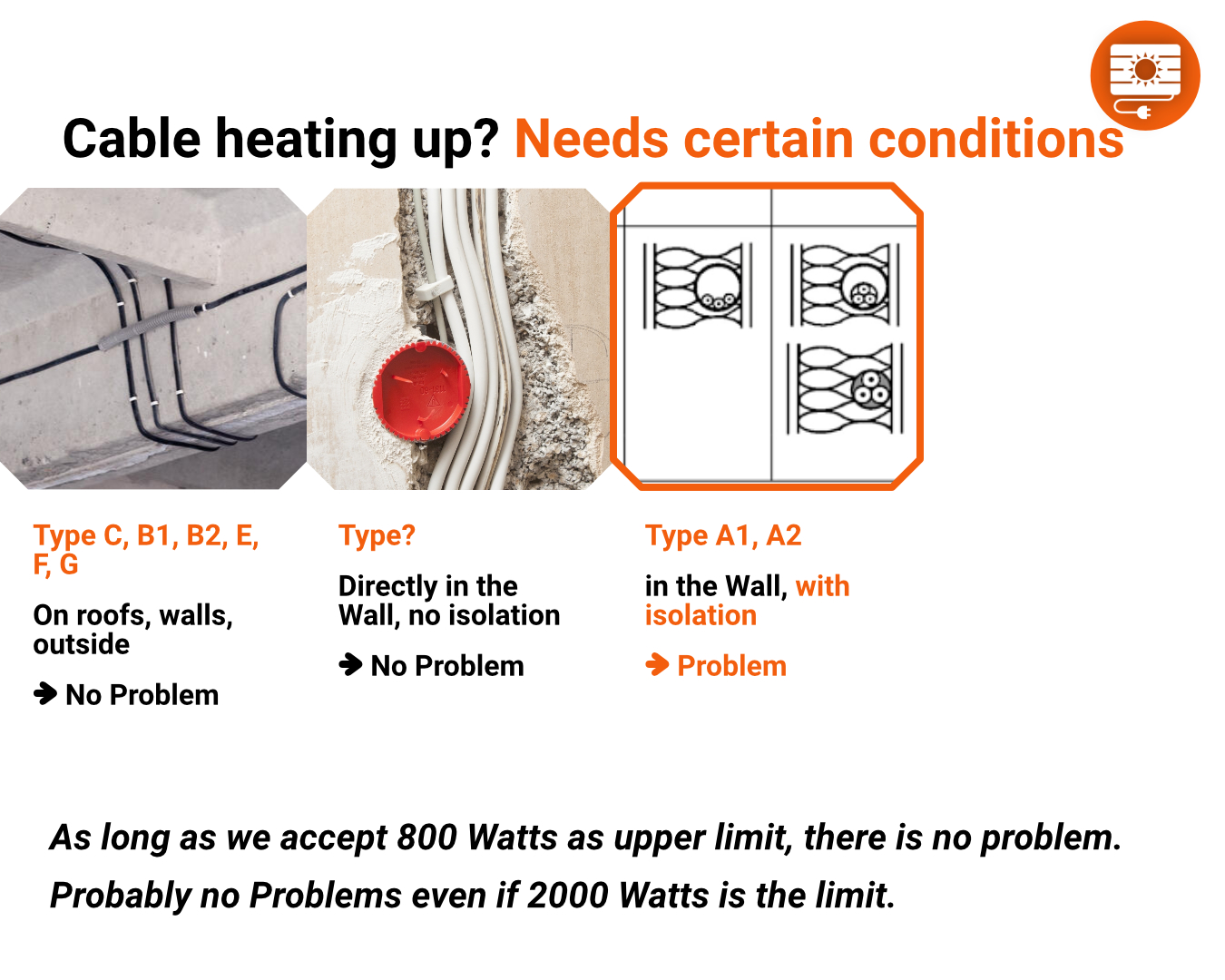
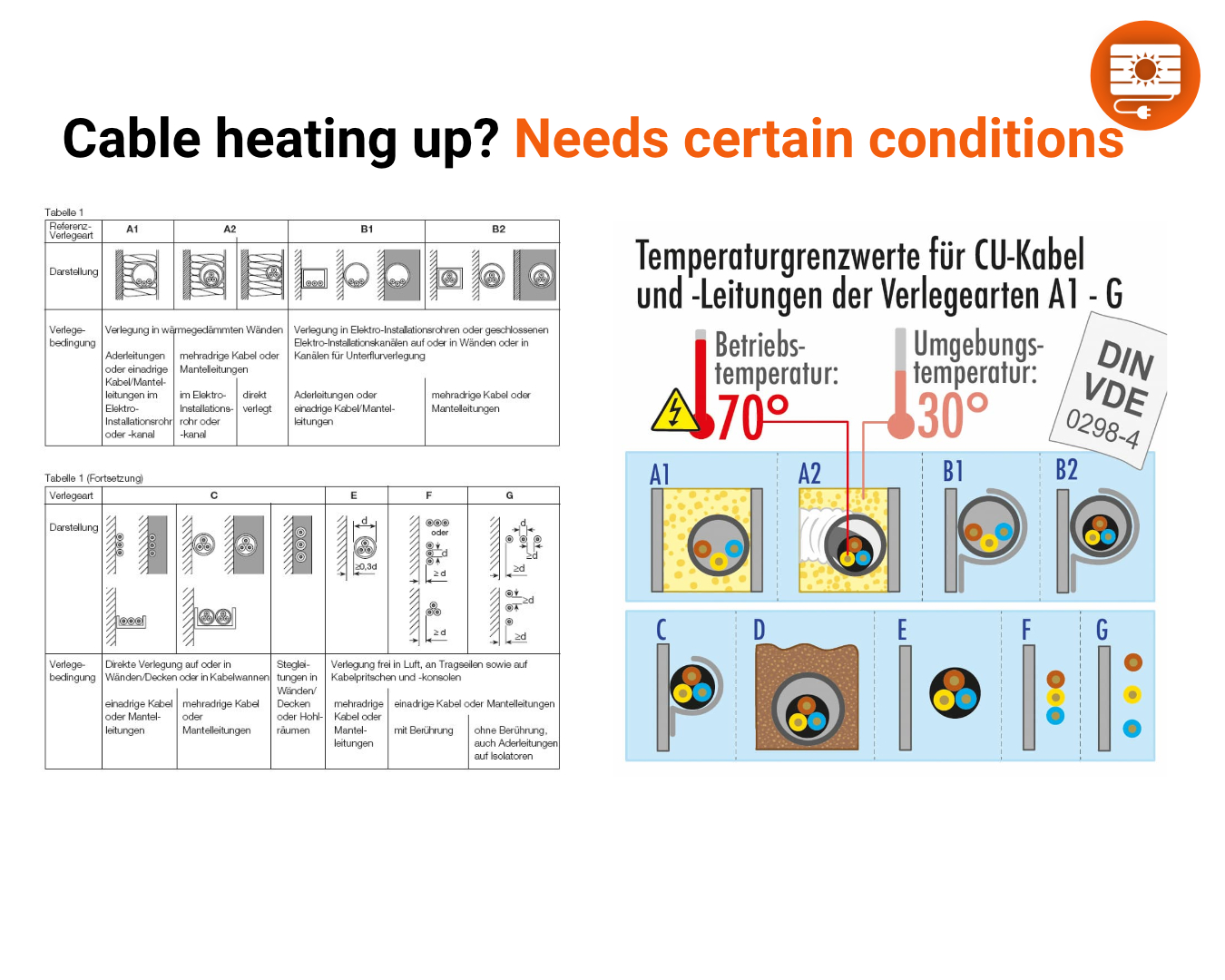
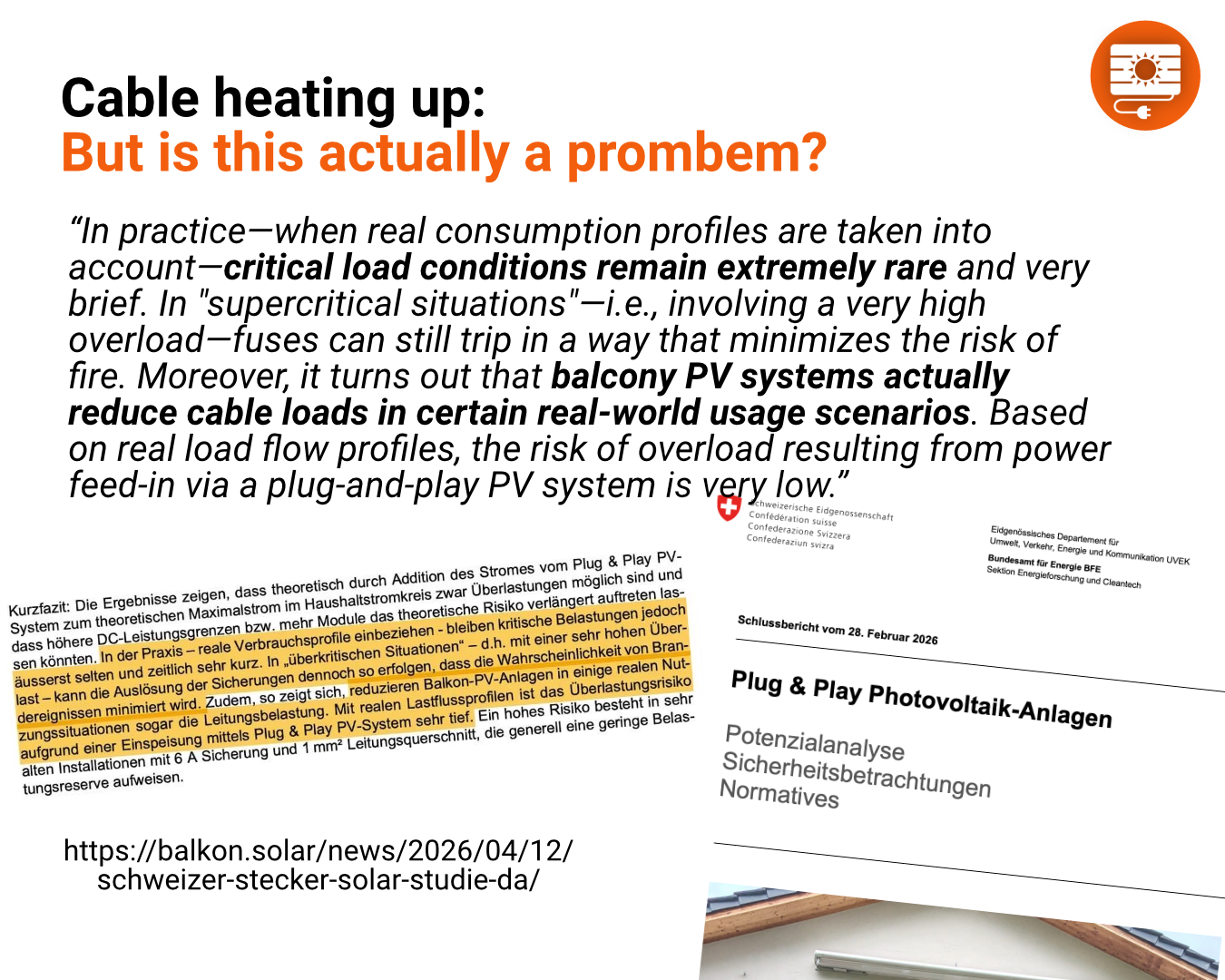
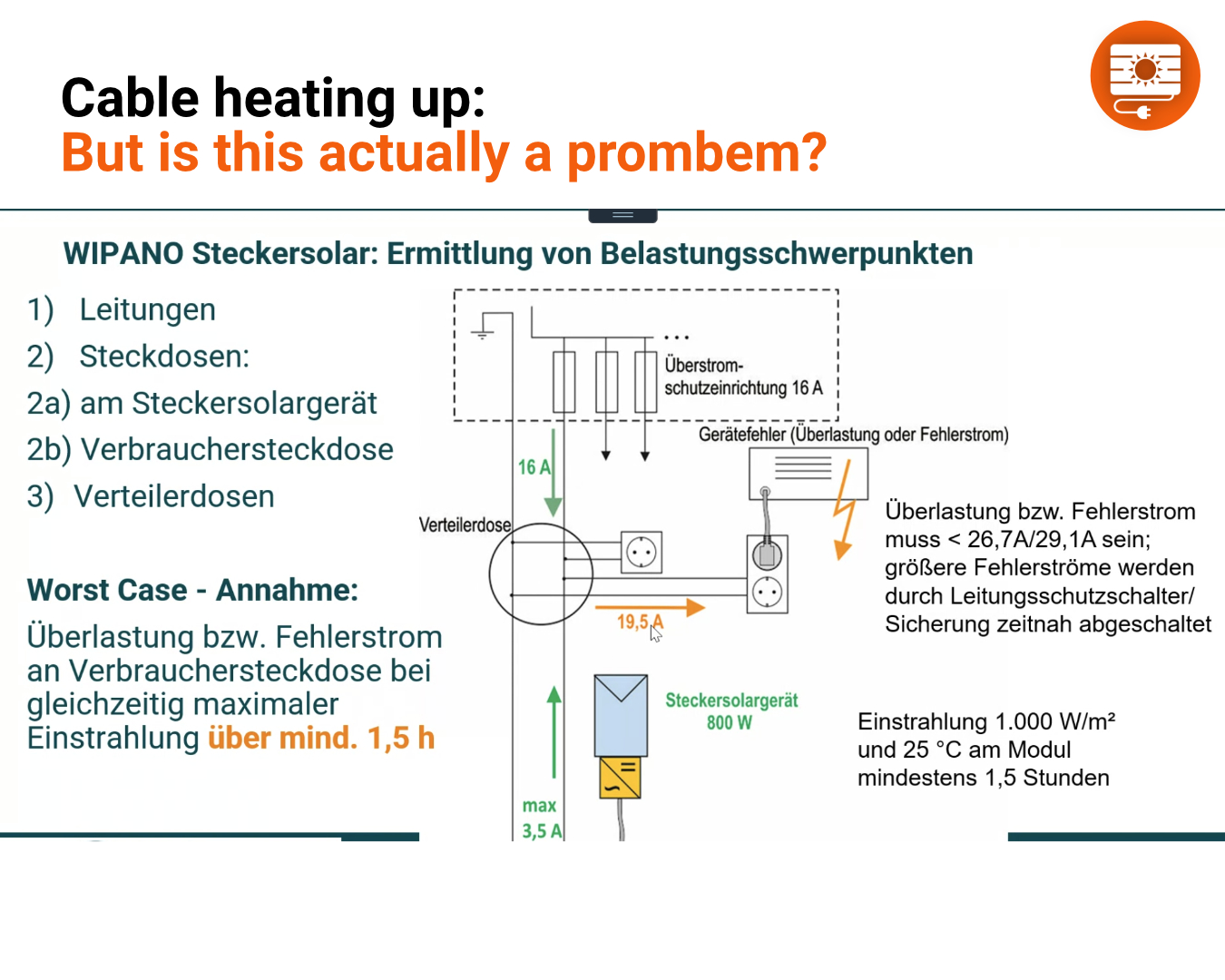
The German study and later the Swiss Safety study did not find cable overheating or melting a problem, as long as you stay below the 800 Watt feed in limit.
Touch Safety
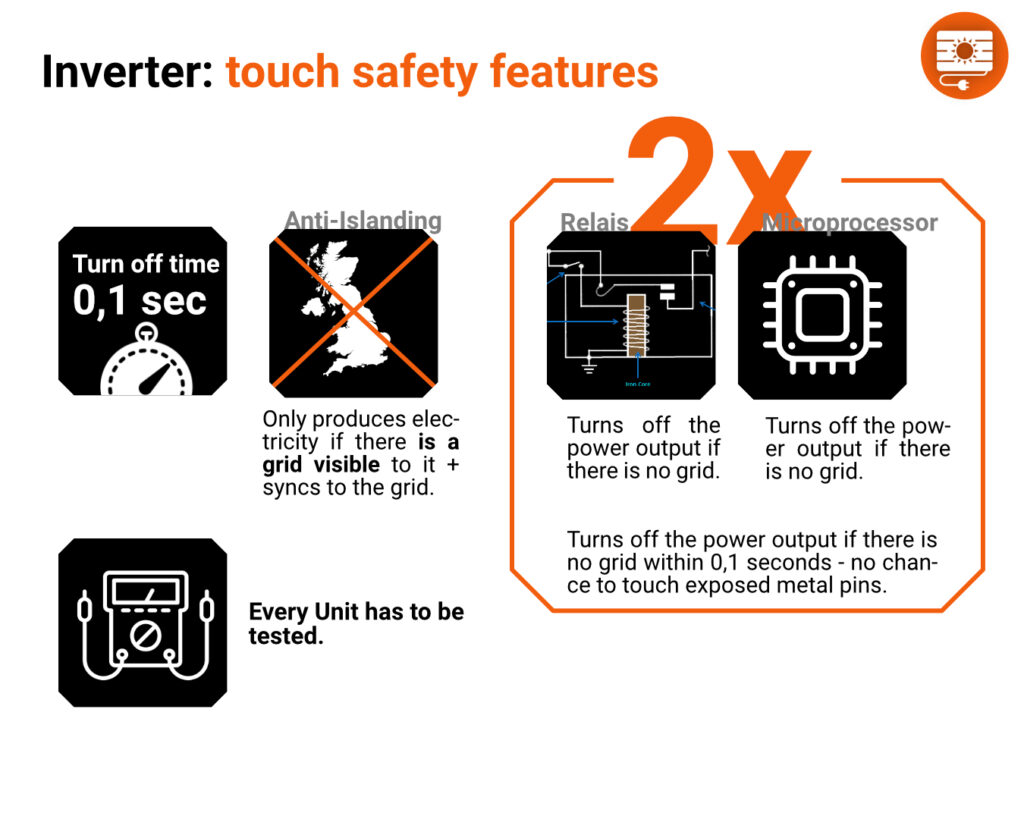
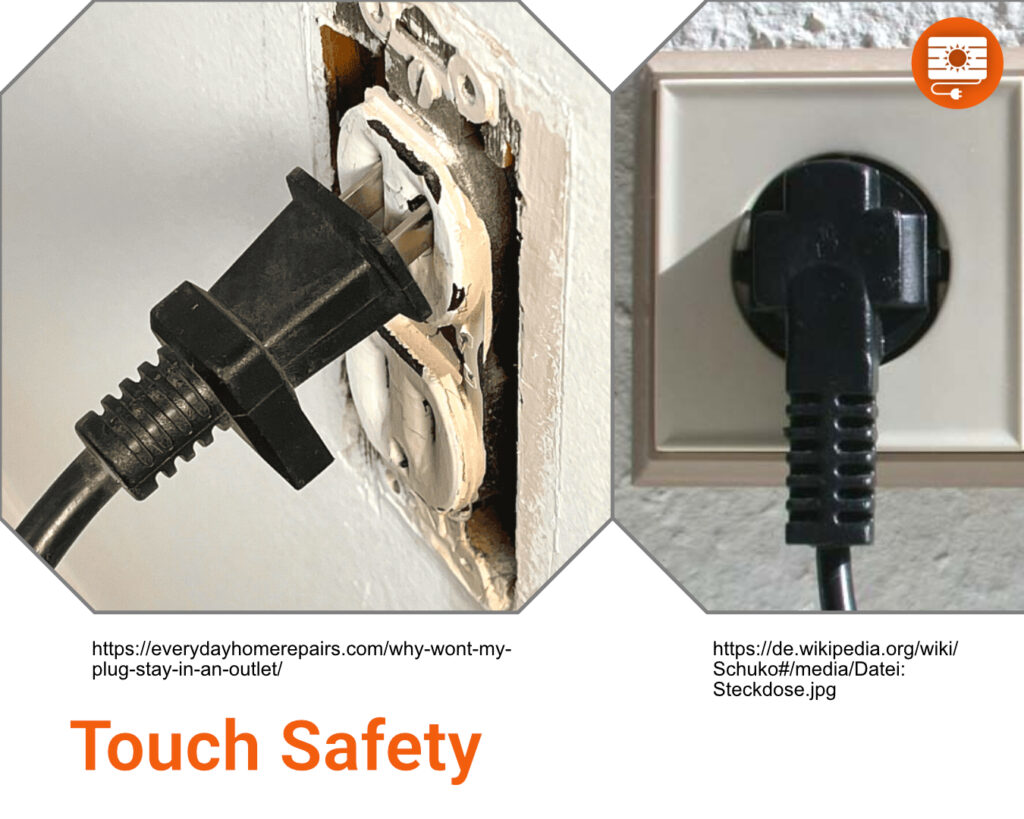
Touch safety is ensured by two provisions: The inverter has to turn itself off within 0,1 second – that is more stringent than any other household electric device. And this shut off function has to be checked not only for the specific type of inverter in general, but for each device separately. Only then does the standard allow for the use of a Schuko Plug with its possible exposed metal pins.
American Suicide Cord Discussion
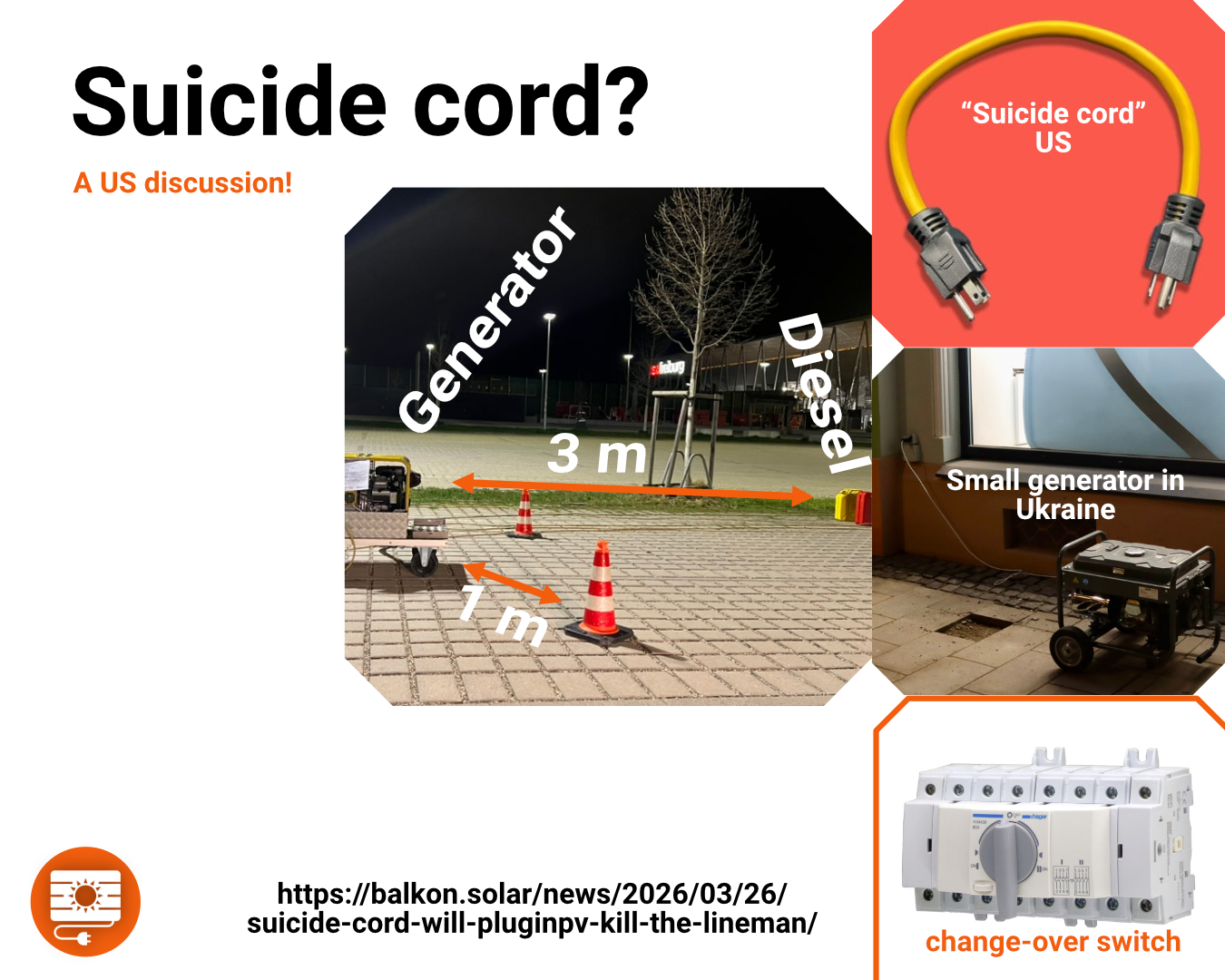
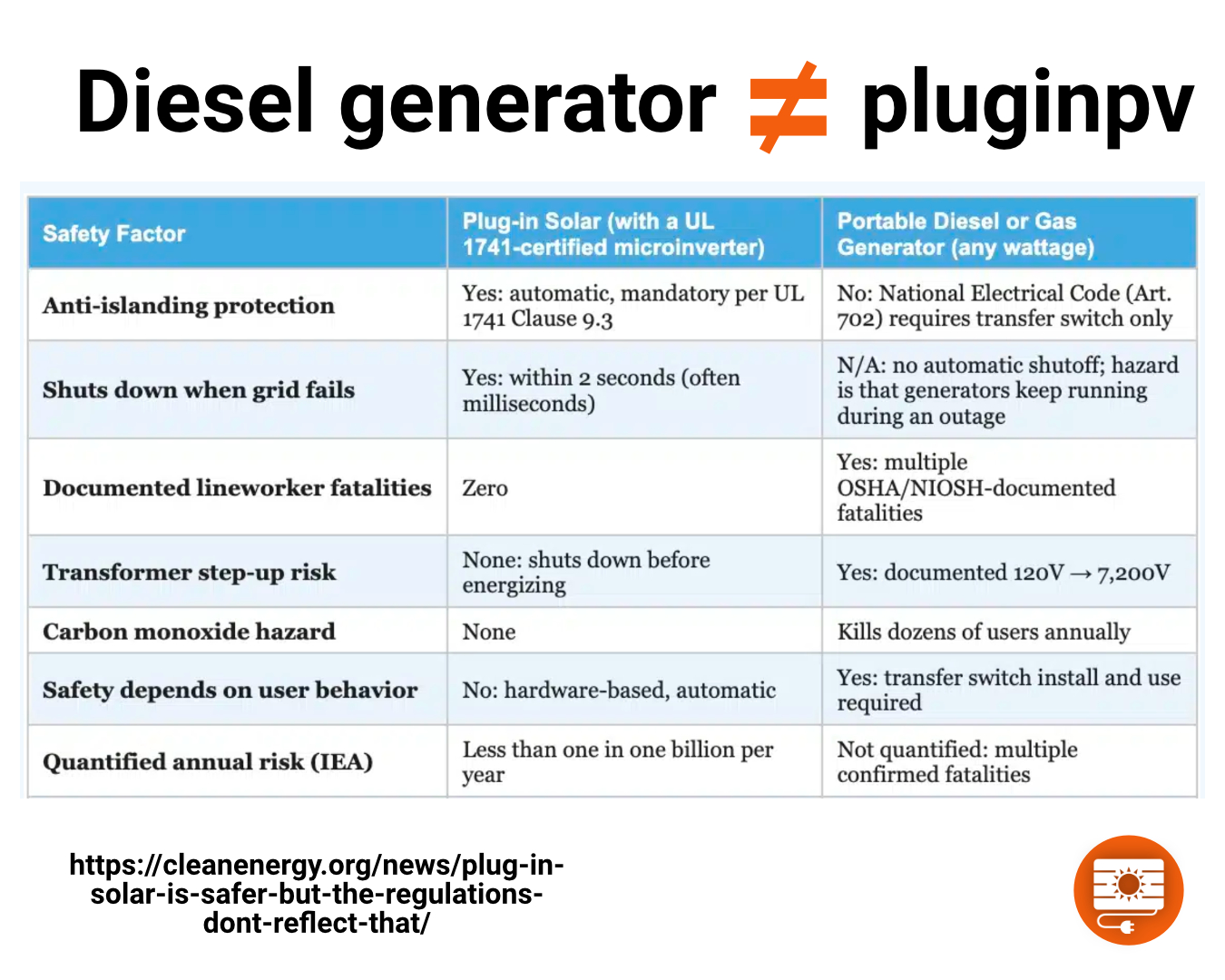
Repeatedly Americans came up with the „Suicide Cord“ Discussion. This seems to be a problem when people connect their house to a diesel Generator and don’t have a change over switch. Then the electricity from the house can flow into the grid and onto the transformer and thus a line that is supposedly not under electricity has power on it. This can be a problem for the lineman.
For a comprehensive discussion see: https://balkon.solar/news/2026/03/26/suicide-cord-will-pluginpv-kill-the-lineman/
Mounting
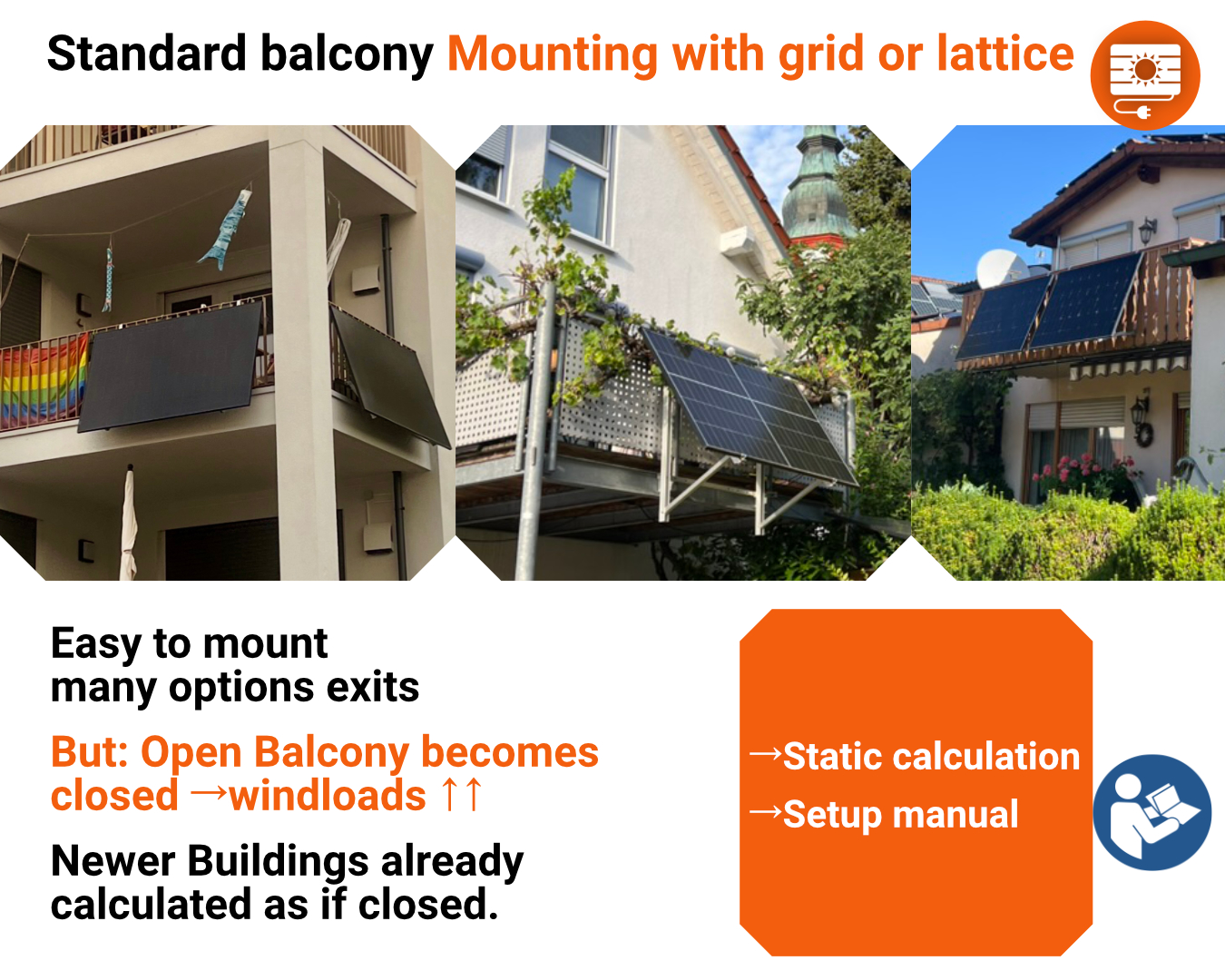
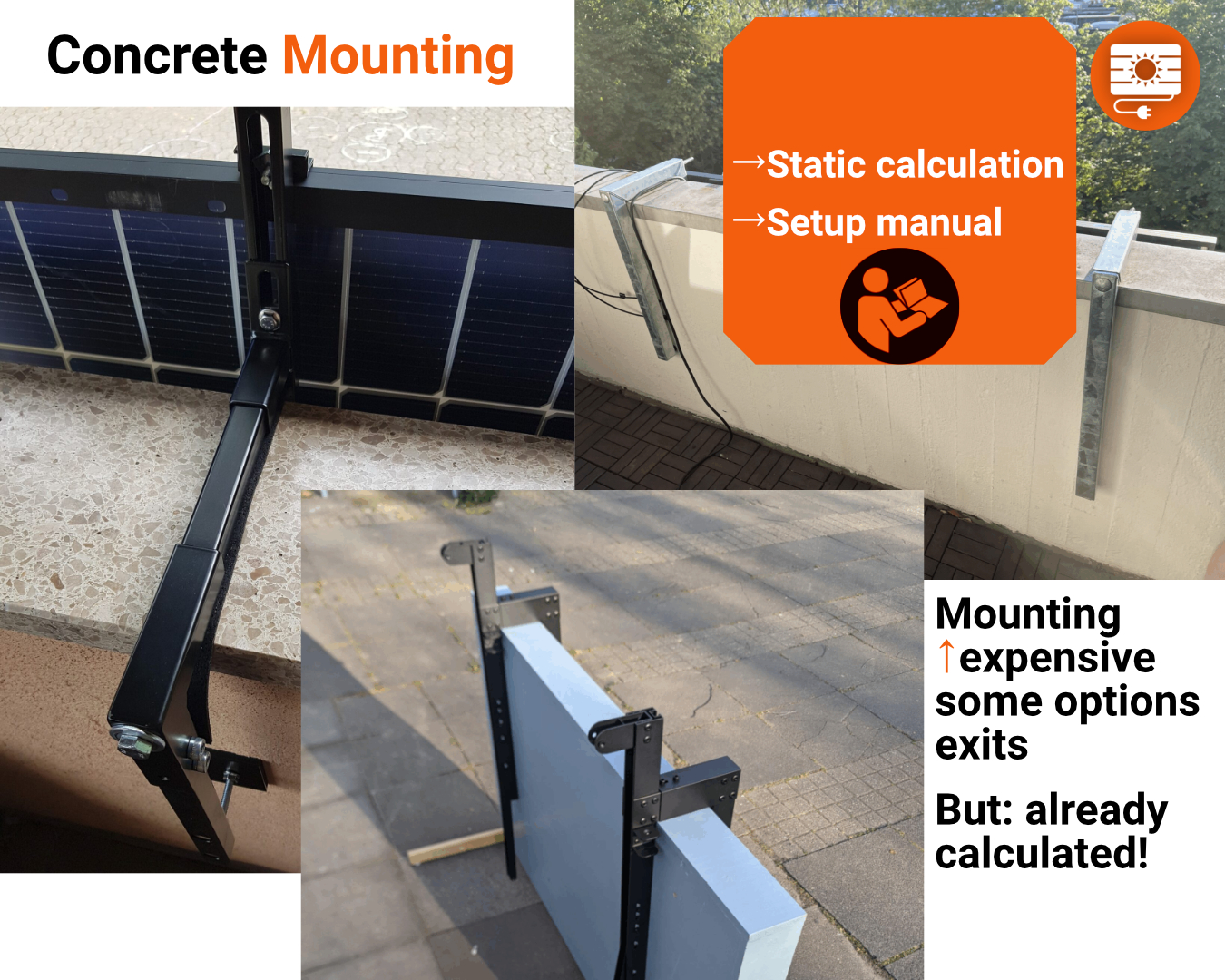
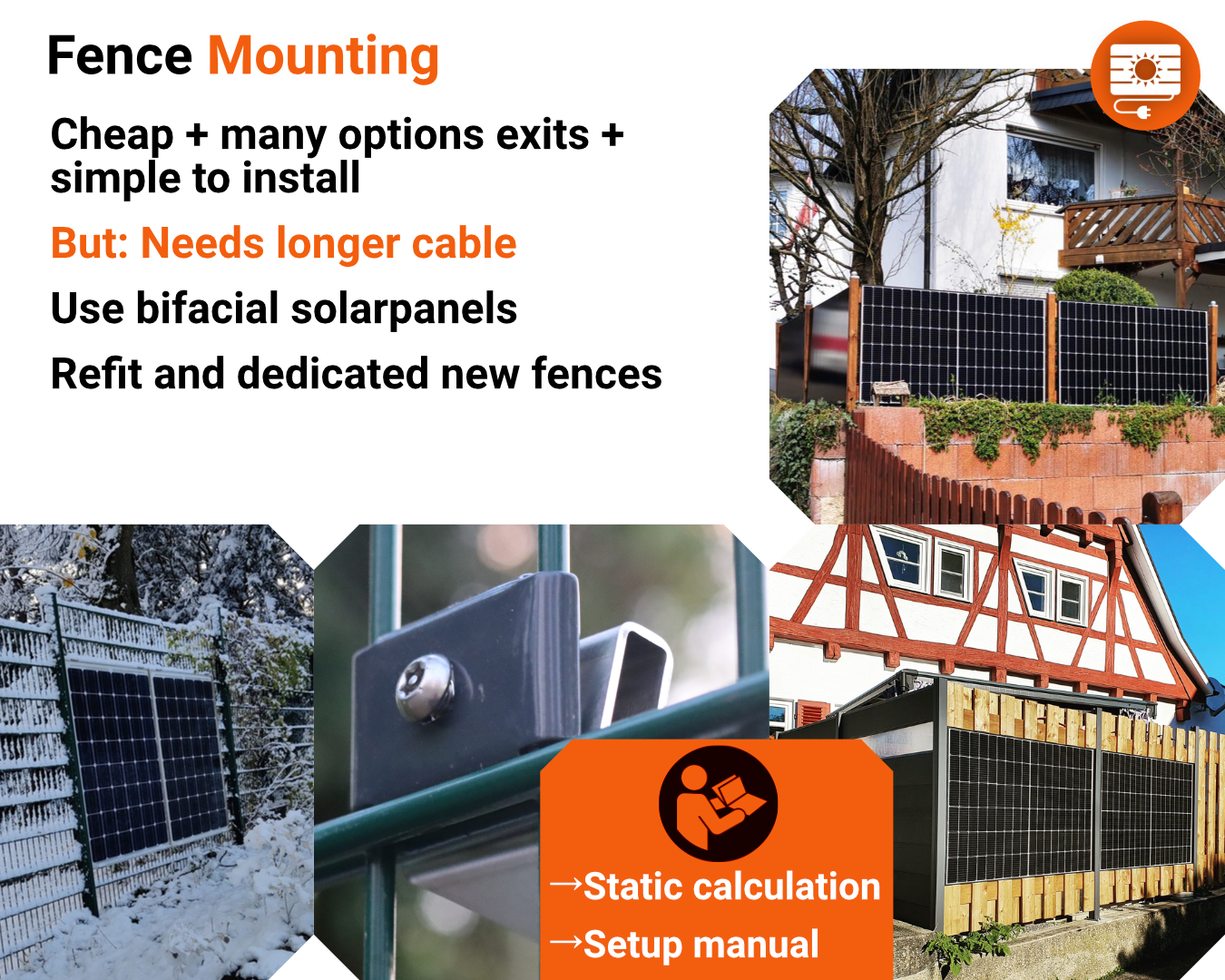
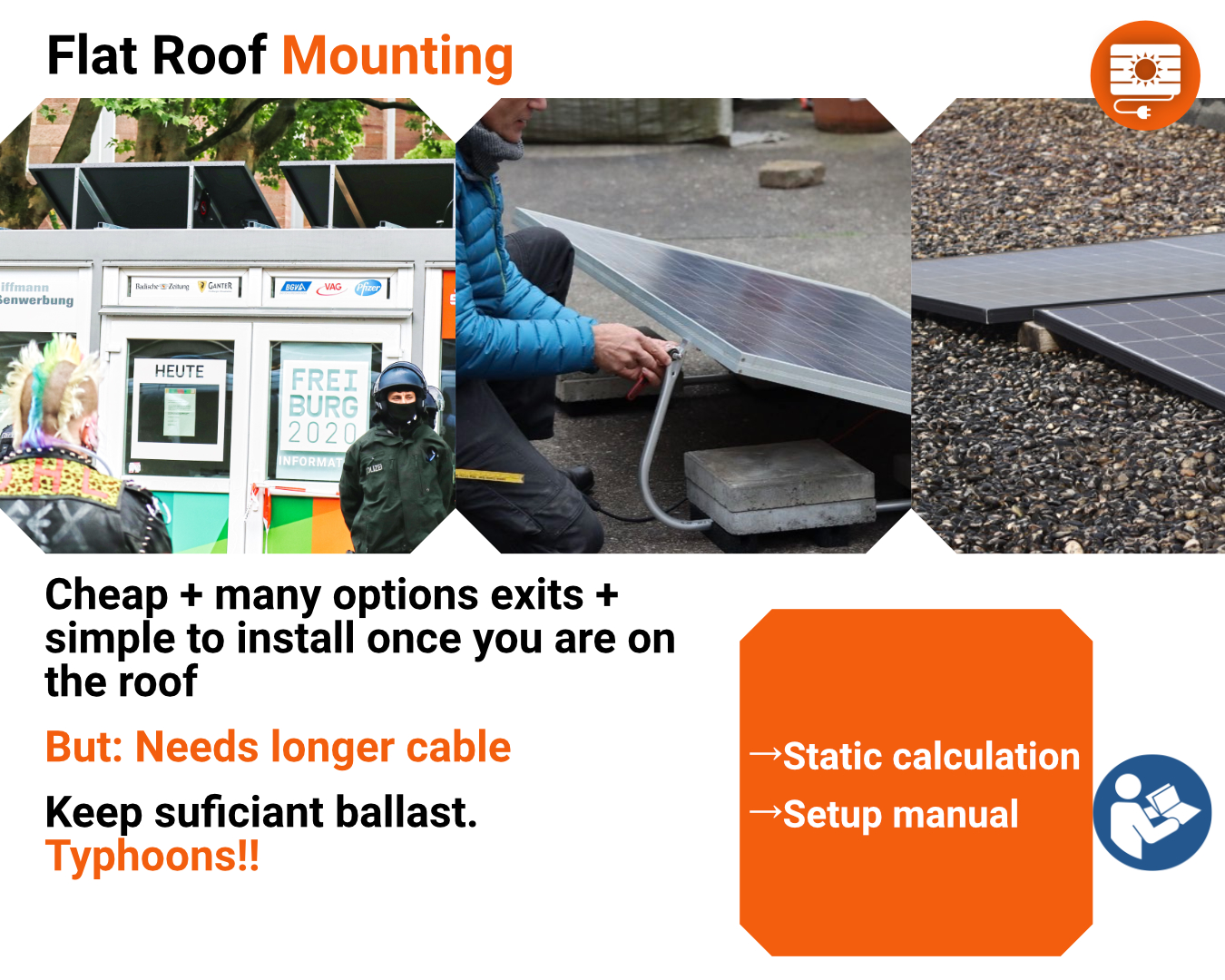
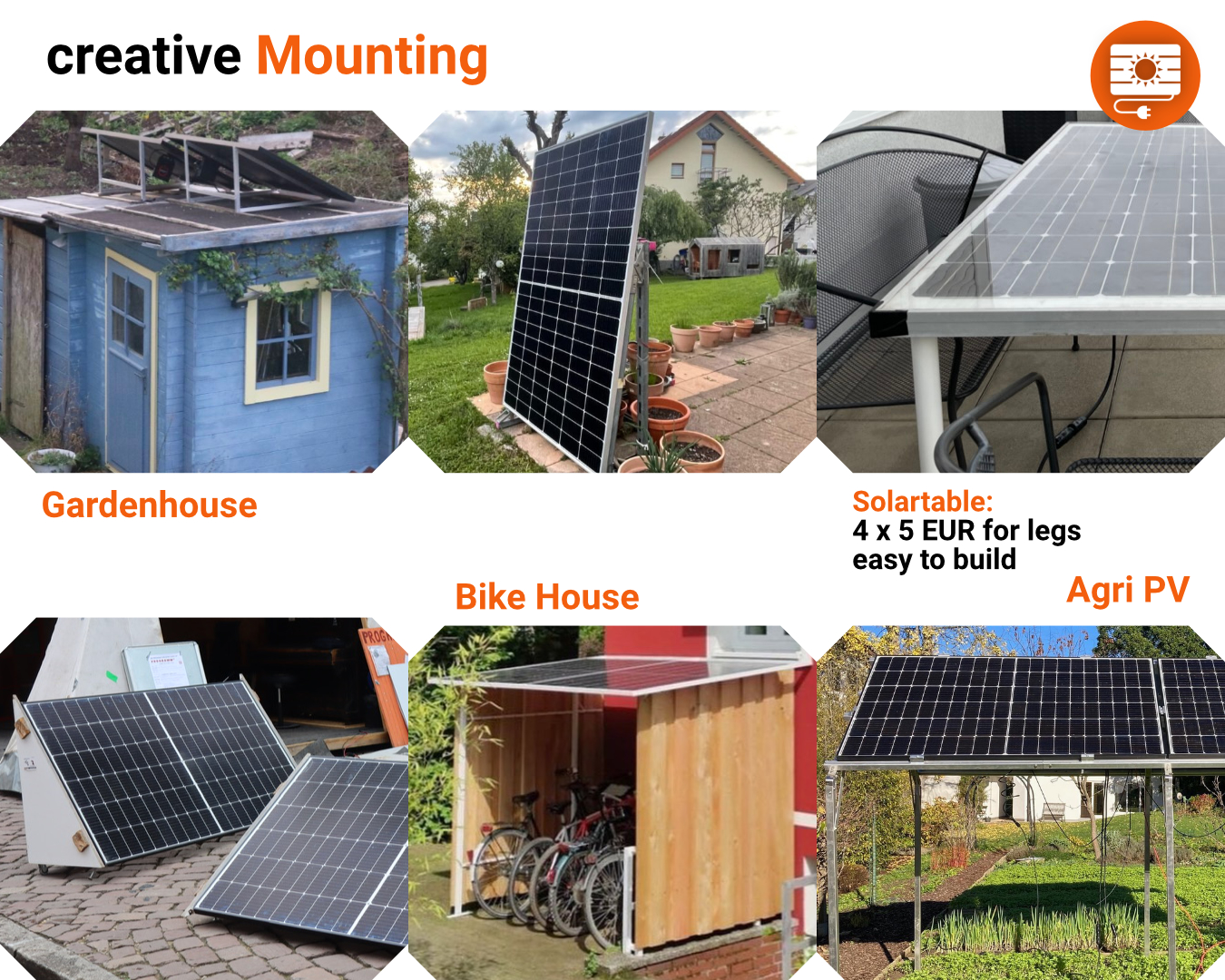
The safety issues around mounting are solved. Commercial providers of mounting have liability when they sell it to people. Otherwise a good manual is essential. However this is not a new requirement for commercial products.
Legal Framework
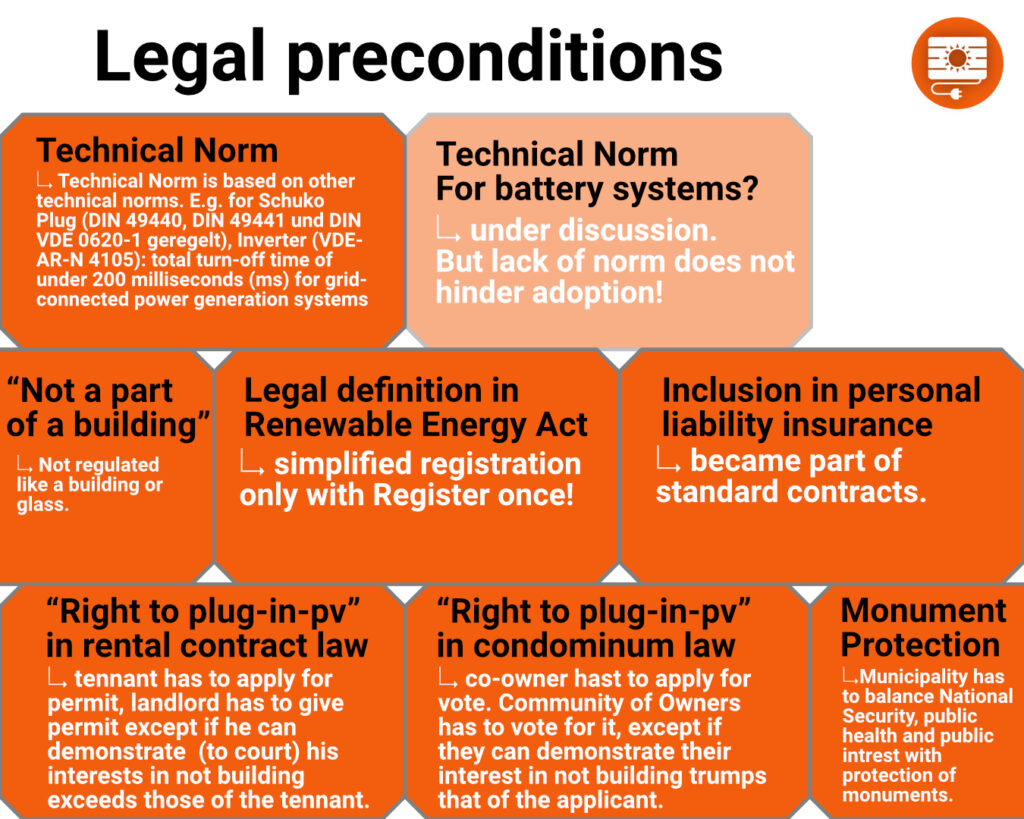
For a discussion of the German technical standard see: https://balkon.solar/news/2025/11/22/what-does-the-new-german-plug-in-pv-norm-say/
For an overview of the legal situation see: https://balkon.solar/news/2024/10/17/germany-grants-renters-the-right-to-install-solar-systems-on-balconies/
Appearance
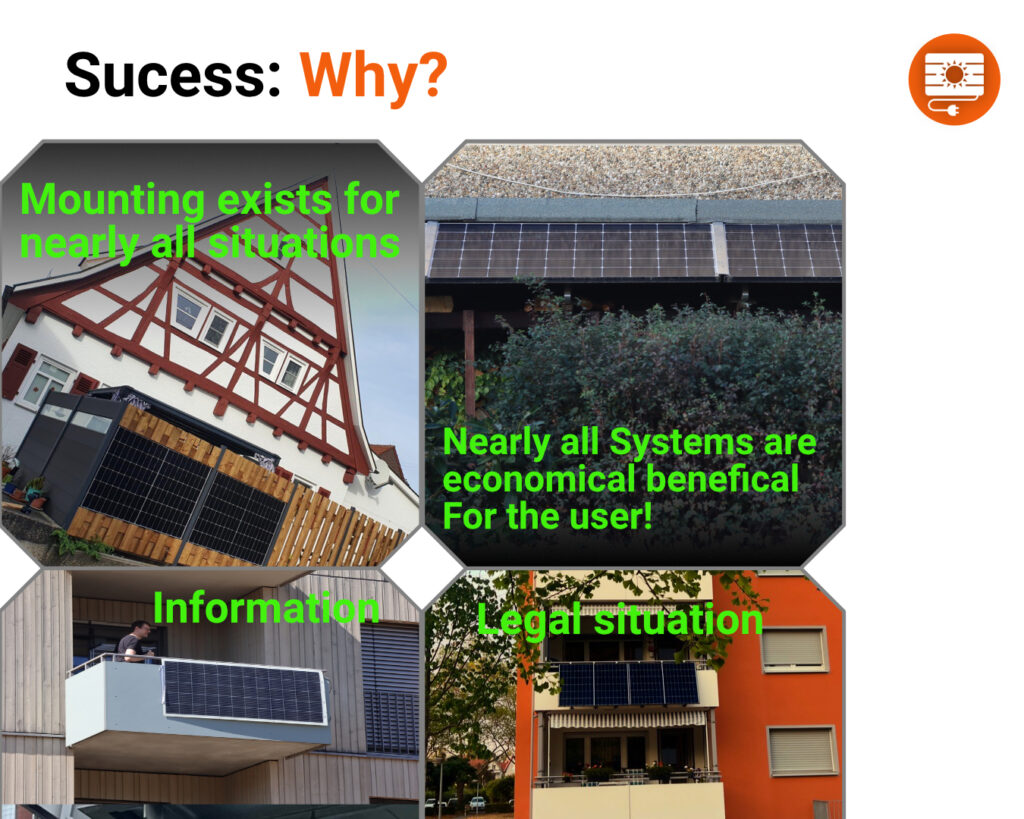
Appearance – if you put solar panels on your balcony, garden, roof, fence people can see that and it changes the appearance of your house. There is in principle no way around it. You can use more expensive looking panels such as glas-glas semi transparent panels, expensive coloured panels or choose a location not facing the street.
In general there is no way for neighbours or authorities to stop you. Architects‘ copyright is only an issue if you live in an outstanding specially designed building and have not bought the rights to your building. There are no cases of that known to us. Often it helps to visualize how the building would look like with it.
Monument Protection
Monument Protection – In Germany Monument protection has to be balanced with the need to expand the use of renewables. Both are considered to be in the public interest. This gives owners or renters a good leverage to argue for a permission to add plug in solar, which is also less of a permanent change to the structure, than a rooftop system. However, monument protection authorities usually try to discourage interested home owners informally. So that the interested home owner does not put in a formal application.
Glare
In Germany you have the right to reflect light onto your neighbours ground for up to 30 min on 30 days. It does not seem likely that you can actually do this with a balcony mounted solar panel.
To quote our Website: “PV modules are typically manufactured using specialized solar glass, and the vast majority (approx. 90%) feature an anti-reflective coating. Such a coating allows the reflectance of the front glass to be halved—from approximately 4% to about 2% (assuming perpendicular incidence). Consequently, compared to windowpanes or glass facades, PV modules exhibit lower luminance levels because significantly less light is reflected.
At a distance of 25 meters from the balcony solar system, the maximum daily duration of reflection is less than 30 minutes. Due to the sun’s changing path throughout the year, reflections may occur for up to four weeks—albeit for a shorter duration—in a worst-case scenario. This limits the total annual duration of glare at an immission point 25 meters away to approximately 7 hours.”
Consumer education
The standard knowledge and abilities of the „reasonably circumspect consumer“, e.g. a person that knows how to set up IKEA furniture or plug in any electrical device can use a PIPV system. The direct current connectors are protected against polarity reversal because they only fit if they are applied correctly. DC connectors have no exposed pins. AC cable can be operated as any other AC plug and socket.
We should also keep in mind that basic knowledge about electrical circuits is part of the Elementary school curriculum (Grade 3 and 4 in Baden Württemberg) and Basic safety precautions are taught again in Grade 7.
Introduction of PIPV should be accompanied by consumer education and systems sold should have quick and extensive user manuals.
Questions to be asked
These are some questions you could consider in the future.
- Is pluginsolar legal, illegal or in a grey area? Grey area might be, nobody has thought about it at the time the law was written. E.g. technical regulation just did not think about it.
- Should you check or research how old electrical installations cope with it? What distribution of old and new installations are there? If we make a technical standard or recommendation, maybe we can say “if the installation is from 1990 or later, then…”
- Should it be an aim to organize a group or NGO that takes care of the topic and has some funding?
- Is this a commercial thing or a more of a community organizing / social thing
- What fears do people have and how can we alleviate them?
- Have many houses outside sockets? Or do you need to use flat cables?
- How expensive is getting an outside socket? How easy is it to find an electrician?
- Do we need safety data on flat cables that go through windows?
Further reading
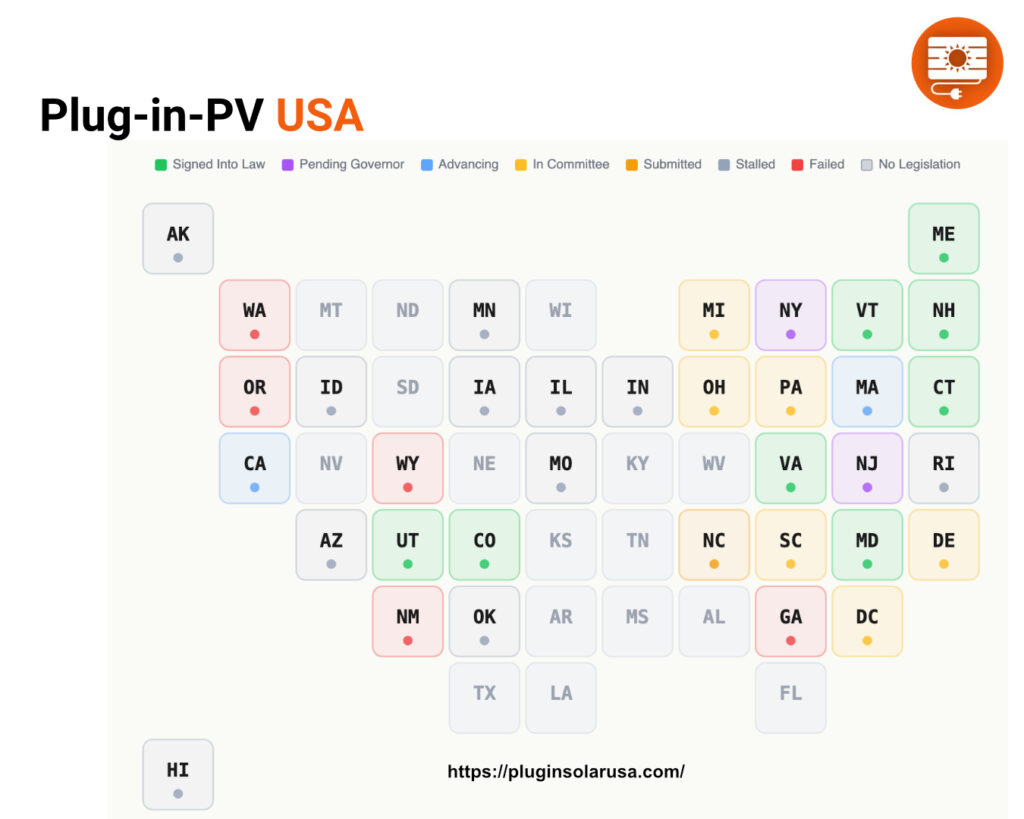
Southern Alliance for Clean Energy, “White Paper: Disproportionate Regulation of Residential Plug-in Solar”, is from a US NGO arguing that pluginsolar is far more regulated compared to diesel generators. You find it at: https://cleanenergy.org/wp-content/uploads/SACE_PluginSolar_WhitePaper_Final-V.7_2026.pdf – and it is really worthwhile reading especially in regard to the US discussion around “suicide cords” and “killing the lineman”.
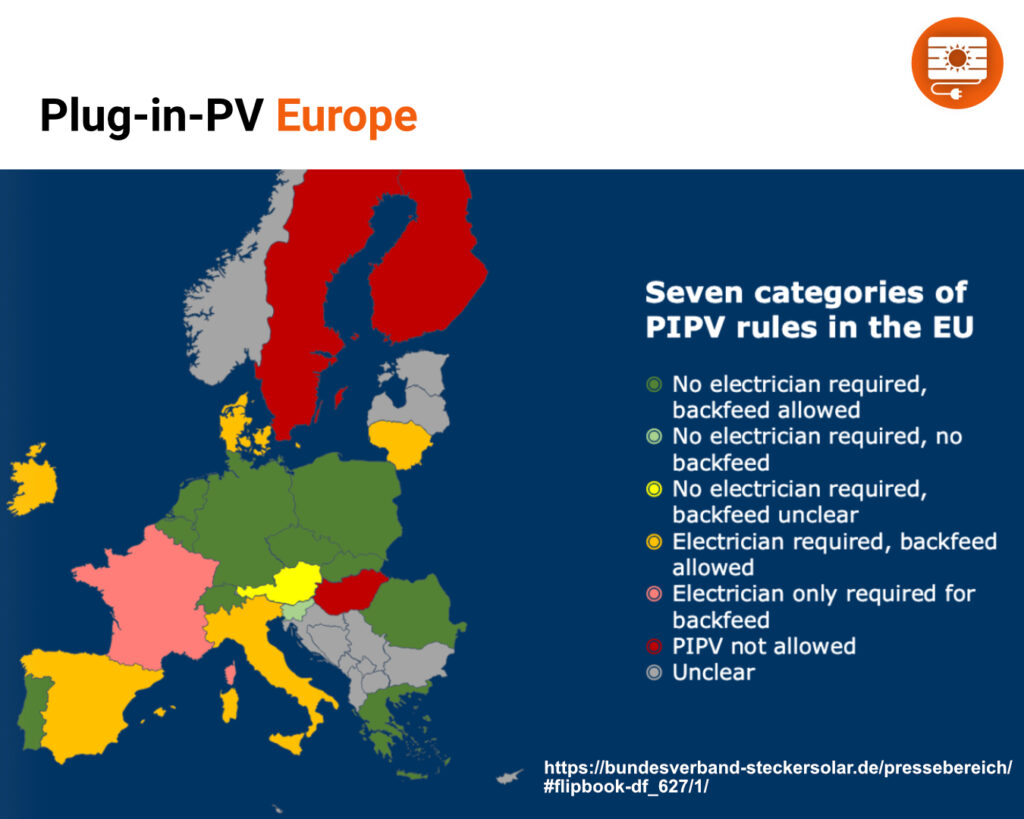
Arceio, “RAF013/2526 Plug-in PV Systems in the United Kingdom” is the study produced for his majesties government. An assessment combined standards-based analysis with laboratory testing and representative simulation of UK domestic circuits, examining a range of operating conditions and fault scenarios across different device types. Available at: https://www.gov.uk/government/publications/plug-in-solar-electrical-safety-study
The BalkonSolar Verein has a “Second Life Magazine” with lots of instructions on how to reuse old Solar Panels. https://balkon.solar/news/2025/05/28/solar-secondlife-magazine-draft/
UL, “Safety Considerations for Plug-In Photovoltaic (PIPV) Systems” at https://www.ul.com/insights/safety-considerations-plug-photovoltaic-pipv-systems